Electrical monitoring starts with a clear question: what value does the control system need to observe? In a transit substation, that might be current on a feeder or power measured in watts. Transducers provide signals for supervisory control and data acquisition (SCADA) systems to use.
The Swartz Engineering transducers page describes watt and current transducers for SCADA applications in transit substations. It gives engineers product details to consider, including input and output characteristics, power supply, isolation, and calibration.
What a Watt Transducer Reports
A watt transducer measures power using voltage and current. Swartz Engineering’s page says its Watt Transducer multiplies voltage and current in the high-voltage section, then sends the watt output through a full-wave FET chopper. The page describes this as providing high-voltage isolation between feeder circuits and the current-loop output.
The product is described as designed for SCADA requirements and the transit-substation environment. It operates from a DC housekeeping battery supply without a separate AC inverter. The output is a bipolar current source that tracks the input signal.
What a Current Transducer Reports
A current transducer provides a signal related to current input. The page describes Swartz Engineering’s Current Transducer as a solid-state unit for SCADA systems in transit substations. It lists a +100 mV full-range input and a bipolar current-source output that tracks the input signal.
These details help distinguish the current transducer from the watt transducer: one is described in terms of current input, while the other produces a watts output based on voltage and current. The right measurement depends on what the monitoring system is designed to observe.
Details to Compare Before Selection
Before specifying a transducer, engineers can review the measurement needed, the input range, the output signal expected by the control system, and the available DC supply. They can also confirm how the device connects to feeder and control circuits, what isolation is described, and whether the installation allows the listed mounting orientation.
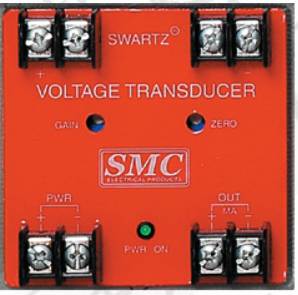
The page describes gain and zero adjustments for calibration or intentional offsets, along with screw-terminal connections. These are useful specification points to compare with a project’s installation and commissioning requirements. The product page also provides a datasheet and specifications for further review.
Match the Device to the Measurement
Watt and current transducers serve different measurement needs. Reviewing the required input, output, power source, and connection details helps engineers assess which product information is relevant to a transit substation’s SCADA design. The datasheet can then be checked against the project’s electrical and installation specifications.